Podcast: Play in new window | Download
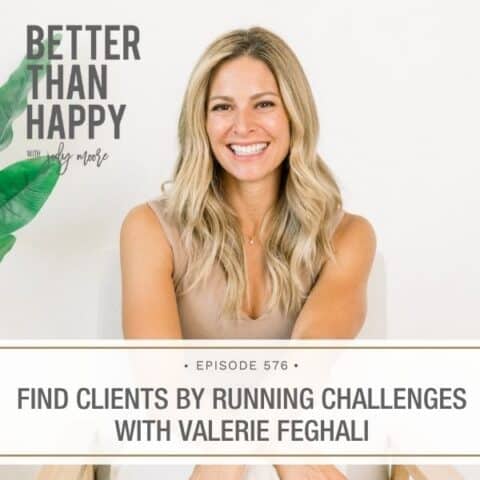
What if finding clients didn’t have to feel like constantly convincing people to work with you? What if instead, you could create an experience where people get a real result, see what you’re capable of, and naturally want more?
In this episode, I’m talking with health coach and founder of The Wellness Vault, Valerie Feghali, about one of her favorite ways to serve potential clients and grow a coaching business: running challenges. Valerie shares how she began using challenges to grow her own coaching business and why they can be such a powerful way to help people experience a quick win, build trust, and see the value of working with you.
Join us this week as Valerie shares how she went from struggling to get traction as a new coach to using challenges as a way to bring people into her business, create momentum, and help clients experience the value of coaching before making a bigger commitment. You’ll learn how to think about challenges as a marketing strategy, how to design an experience that actually helps people transform, and the mistakes to avoid when creating your own. Whether you have a large audience or you’re just getting started, this episode will give you practical ideas for connecting with potential clients and creating a natural next step into your coaching offer.
Valerie’s 5-day Challenge Builder Bootcamp is happening from August 10th to August 14th, 2026. Secure your seat for free here.
What You’ll Learn on this Episode:
- Why challenges can be a powerful way to find clients and grow your coaching business.
- How to use a challenge as a lead-in experience instead of making it the final product.
- The difference between a challenge, a webinar, and a course when it comes to client transformation.
- How to create a challenge with a clear outcome, simple deliverables, and daily touchpoints that keep people engaged.
- The 3 biggest mistakes coaches make with challenges.
- Why showing your face and letting people see the real you can help build trust with potential clients.
- How to make sure your challenge naturally leads into your next-level coaching offer.
Mentioned on the Show:
- Call 888-HI-JODY-M or 888-445-6396 to leave me your question, and I can’t wait to address it right here on the podcast!
- Come check out The Lab!
- Follow me on Instagram or Facebook!
- Subscribe to Jody Moore Coaching on YouTube
- Grab the Podcast Roadmap!
- Valerie Feghali: Podcast | Instagram
- The Wellness Vault
Episodes Related to Finding Clients as a Coach:
- 473. Why You Don’t Have Clients to Coach
- 511. There’s Only One Way to Succeed as a Coach
- 571. Aim for B- Work

If you are a coach or you run some kind of similar online business, you’re going to love today’s podcast episode. My friend, Valerie Feghali, is an expert in running challenges, and today she’s giving us all of her nuggets of wisdom. Welcome to Better Than Happy. Find Clients by Running Challenges. I’m Jody Moore. Let’s do it.
Welcome to Better Than Happy, the podcast where we apply all the tools of psychology, human behavior, and mindfulness to live our best lives, navigate challenges, and achieve our goals. I’m Jody Moore and I’ll be your coach today. Let’s do it.
Hey there, everybody. Welcome to the podcast. I got to talk to Valerie Feghali recently, and in our conversation, we’re going to share with you how we met one another, how we know each other. So I will go ahead and save that for just a minute, but Valerie was so kind and generous to come on here and share her insight and experience in running challenges. Such a great way to serve people, to get your name out there, to make an impact, and ultimately to grow your business. But I want to tell you just a little bit about Valerie before we dive into my conversation with her.
Valerie spent 11 years working as a doctor of physical therapy before she realized that the thing her patients needed most was guidance on foundational health and nutrition. She left her physical therapy clinic to become a holistic health coach. She found that she loved coaching, but the content, the tech, and the delivery presented a massive learning curve, and she saw other coaches struggling to find resources that helped move them past these obstacles. Over the years, she began building tools for other coaches and taught them how to build successful businesses.
Today, Valerie’s the founder of The Wellness Vault, the content and client success app used by more than 2,500 health and wellness coaches. And she’s the host of the Fuel the Flow podcast. She believes you don’t have to do it alone and that there’s always a way to grow your business with less overwhelm, starting with tools that allow coaches to fully step into their role as a leader and mentor. I’m so excited to share with you this conversation with Valerie Feghali. Please enjoy.
—
Jody Moore: Okay, let’s dive in.
Valerie Feghali: Okay.
Jody Moore: I thought it would be fun. We’ll tell people how we know each other.
Valerie Feghali: Okay.
Jody Moore: But maybe first, why don’t you give us a little bit of background just about who you are and how you got into doing what you’re doing?
Valerie Feghali: Sure. Okay. You want me to just start?
Jody Moore: Yeah, just dive right in.
Valerie Feghali: Okay. Okay. So what we have now, so our flagship product at this point is The Wellness Vault. So we work with health and wellness coaches to help them get content that they need for their clients to get success. So that could be meal plans, challenges, which we’ll talk more about today, protocols, and all of that, those things that just take coaches a lot of time to build. And it’s draining because really what they want to be doing is coaching. The coaching is the fun part. The coaching is why they got into this. They’re not a design professional. They don’t want to be spending hours in Canva.
So we started creating that for them to be able to do custom work because we know in the health space that it needs to be able to be customized. So all of our plans are customizable. And now we’re developing an app where they can actually deliver that too and they can log their client’s food. They can send them notes, they can send them community and communication all via the app, which has been amazing. But all of this really started with me being in their shoes.
Jody Moore: Yeah, I was going to say, you must have been a health coach.
Valerie Feghali: Yes. So I started my career as a physical therapist. When my mom got sick with cancer, I saw kind of the lack of holistic health being a focal point in the medical space. And so with that gap and with seeing what was going on with my patients as a physical therapist, I started to transition more into the holistic health coaching space, which I loved and found true joy in.
But while coaching, I realized there’s just not these resources out there, and I was spending so much time on the back end, creating all this stuff when really I should have been there holding my client accountable, being there for questions, being there to, you know, adjust their plans as needed instead of playing in Canva, right? And so that’s why we shifted, and now I’m more on the business side, helping other coaches, and I love it. This is my calling. This is where I’m meant to be. And so I get to help all these incredible coaches make a difference in so many people’s lives. And I love to be able to support them because the work that they’re doing is so meaningful.
Jody Moore: That’s awesome. So Valerie and I met through a mastermind that we’re in. We’re both in a seven-figure mastermind in a room full of pretty amazing people doing all kinds of different things. And we happened to be sitting by each other, and we, I feel like, had just so many things in common. We both work with coaches, obviously, but we’re both moms. You’re younger than me with some younger kids, but you know, and we even kind of live near each other in Southern California area.
And anyway, we just started connecting and realizing like, “Oh my gosh, and you have expertise though, and resources and knowledge that I don’t have, and we have slightly different focuses.” And so immediately we were like, “We have to help each other because my audience needs what you have, and your audience might need a little bit of what I have.” And anyway, it’s just been really fun to get to know you and mastermind with you in that group.
Valerie Feghali: Absolutely. It’s been so great. And one of the first things I noticed is your style. You have incredible style.
Jody Moore: Oh, you’re so sweet. Thank you.
Valerie Feghali: But yes, I mean, you are just, the moment that I heard you, the first moment that I ever heard you talk, I’m like, “Oh, wow, she is a brilliant marketer.” And so I need to learn from her, and I need my coaches that I work with to learn from you as well.
Jody Moore: Yeah. So anyway, I’m excited that you’re here. We’ve been talking about this for a while, and we’re going to dive into a part of marketing that I actually don’t have very much experience in. I was trying to think about this the other day when I knew you were coming on the show, and I was like, “Have I ever done a challenge really?” I know I’ve thought about it before, but I don’t know that I’ve – I’ve certainly never done it the right way. And so I’m excited to learn this from you and maybe try it out myself. But we’re going to, we’re going to dive a little bit into challenges. So tell us about how you got into challenges and why you think they’re so effective.
Valerie Feghali: Yeah, so I started running challenges really early on when I moved on to my own business and was doing health coaching for clients. And I was having trouble getting traction because it’s hard, and you don’t know when you first start your own business, where to start. And so I was reaching out to referral sources, trying to do word of mouth, trying to post on social, and I wasn’t getting a ton of traction until I started hosting challenges.
And I think part of it was that it was fun for me. And that made a big difference because when you’re launching something or you’re going to networking things and trying to get referral partners and you’re not really enjoying that piece of it, it was always a lot of stress for me. When I transitioned into doing a lot of challenges, I realized like I can actually do this on a normal cadence, you know, every quarter or every month because it fuels me and doesn’t steal my energy. It really is fun for me as the host as well.
Jody Moore: That’s a huge indicator. I totally agree with that.
Valerie Feghali: Absolutely. And so when we started, I started very small. My first challenge had six participants, right? And as a lot of challenges do with coaches who are just getting started in hosting challenges. And I did not see that as a downfall. Now I’ve heard other coaches be disappointed with having six. I didn’t feel that way. When I first had six, it was like, okay. And it was a paid challenge. This was a $200 challenge for 12 weeks. It was longer than what I would recommend coaches do at this point. We’ve adjusted our framework.
Jody Moore: I was going to ask you that if you’re doing free or paid, and also I think it would be helpful to back up for just a minute and even define what you mean by a challenge. I mean it sounds obvious, but like, how is this different from a webinar or a course? And are you, are you doing this, I gather that this is like helping bring clients into your business as opposed to something that you’re doing maybe with paying clients or maybe you’re doing both?
Valerie Feghali: Yes.
Jody Moore: You have a thousand questions I just gave you.
Valerie Feghali: Yeah. So when I first started, the challenge kind of was the product, but what I realized after that was that people wanted more after. So those six people, two of them were like, “Do you offer one-on-one? Can I do more group? Can I continue on?” And that’s when it hit me to be like, “Maybe I should be using this more as a lead in, a lead magnet, rather than the product itself.” And so I moved into now doing challenges more as a way to bring people into my business. It’s a marketing strategy to bring people in, get some experience with my coaching before they invest a lot of money and get a quick win so that then when they are in that momentum phase, they’re ready to buy into the next thing. They’ve already matched with my energy. They know how I’m going to be as a coach with them. They’re seeing progress and they’re ready for more and they’re excited for more.
And I think one of the best things about challenges too, so what to answer your question about what a challenge is, it’s something where people are participating in getting their own personal win or result. And so as a health coach as an example, you could run a seven-day sugar detox challenge, right? Where clients are avoiding all added sugars in their food. They are having, you know, whole foods that are from nature, not from a box, right? And so that could be an example of a challenge that you run.
And people go into that challenge knowing it’s going to be hard. Just the word challenge alone implies that this is something that they’re going to have to work towards and participate in. And so it increases our live show-up rates. It increases our engagement because they’re prepared ahead of time to say like, “Oh, this isn’t just like sit back, relax type of thing. Like, I’m signing up for this knowing that it’s going to be a challenge,” right?
Jody Moore: Yeah, and I like what you’re saying about you have a more interested person who really wants a transformation if they’re – because they’re going to show up and do the work as opposed to a course or something where I’m going to sit back and soak in what I want while I’m doing the dishes and maybe pay attention, but it’s more entertaining sometimes, I feel like, when I do these big webinars or courses, I’m like, “People just want to hear me talk.” I mean, that’s sweet and all, but I’m not interested in entertaining you. I’m interested in helping you transform. So you have you have a more interested, committed, more committed person I guess we would say, yeah?
Valerie Feghali: Absolutely. And how many times have people or myself included, signed up for a webinar or workshop and been like, “Well, I’m just going to watch the replay when I have time,” right? Whereas with the challenge, it’s like, “No, this challenge runs from Monday to Friday. You’ve got five days. We’re going to do the work together.” And so, again, it implies that like live component, that now, that urgency, that commitment to doing it. And so people are much more driven and I do believe like you said, you get better people into it, people who are ready and willing to do the work.
Jody Moore: I have participated in a couple challenges too over the years as a participant. and it is very like satisfying to get – you know, I remember this was many years ago, but I did like a decluttering challenge, and I just I remember the first day was like, we’re going to clean out under your bed today. And I remember thinking, “What? Under my bed? Like I don’t even have to ever look there. Why would I do that?” But I did it. And yeah, there’s just something so gratifying about like, okay, I can do this and taking the baby steps.
Valerie Feghali: Yes.
Jody Moore: And I can see that. It reminds me of like when you sign up for like a software platform and they give you a free trial. And so you start building your, editing your video or whatever. And then it’s like, “Okay, do you want to pay for this?” Well, yeah, I want to pay for it because now I’m I’m into this thing. I’ve got the momentum because getting started is the hard part.
Valerie Feghali: Yes. I’ve already started. And it gives people that easy in. Like you said, like I think we can learn a lot from that declutter challenge because how simple is that you clean under your bed. It’s one thing. They’re not asking you on day one to clean your whole kitchen, right? They’re saying pick a drawer, pick under your bed and do that one thing. And making a simple task for people each day of the challenge, just one small thing, can go such a long way. Yep, we get the ball rolling, we get the momentum started, we start to see the differences that this could make if we continue on.
And that’s one thing that a challenge needs to do in order to be high converting is that it needs to also show them the gap. So you need to get a quick win, like you did with, great, under my bed is now clean, right? I didn’t even realize I had that under there. But then you’re like, “Well, what about inside, you know, the bottom of my closet? What about this,” right? So it shows you where you’re lacking and it makes you want to get help in those areas as well too, which should lead into your next level program.
Jody Moore: Okay, love it. So tell me why this is, I know you work primarily with health coaches. Why does this work so well in the health space?
Valerie Feghali: Like I mentioned, it gives them some experience with you first. I think particularly in the health space, a lot of people think, “I know what to do. I just need to stop eating so much and work out more,” right? Like in their mind, it’s like they know what they need to do for their health. But in reality, they don’t. They really don’t know where their habits are falling apart. They don’t know where the simple, low-lift ways that create a lot of leverage in improving their health. They don’t know those things.
And so in the health space, a lot of times with a challenge, again, you’re identifying that the gap. You’re identifying where they still need help, and it’s that self-awareness tool. So when you say, for example, let’s go back to the no-sugar challenge, we’re going to do a no-sugar challenge. This is how you read food labels and look for added sugar in your food. People will start picking things up at the grocery store and be like, “Oh my God, I had no idea this had 21 grams of sugar in it, and I’m having it every morning,” right?
And so it starts to bring that self-awareness into their routines, their habits, where they need continued help. And it shows you, it shows the participant how the coach can effectively do that and point them in the right direction. And so in the health space, again, it’s it’s the hardest thing is getting started. So if we can get that ball rolling and bring some self-awareness around where they can improve and what they still need so much work on, it leads to them wanting to work with you, you know, as a coach continuing to move forward.
Jody Moore: Yeah, okay, that’s awesome. I love that. Tell me about some of the mistakes that you see us make so we can avoid those.
Valerie Feghali: Yes. One of the, probably the biggest mistake that I see coaches make is that they don’t set the expectations of what the challenge is going to entail and tell people how to prepare for the challenge before day one. So what I see a lot of coaches do is they’re enrolling all the way up until the challenge starts at 8:00 AM on Monday. They’re enrolling until 8:00 AM on Monday. And yes, that can be good for marketing, but what if we close the doors to the challenge two days early, and we said, “Okay, doors close here. You can only enroll up until this day, but we’re starting, you know, two days later.”
And that gap gives you time to get the client prepared. It gives them time to access the community, to learn how to get into the community and post a question. It gives them time for you to, if you’re doing some sort of like, let’s say meal planning challenge, for you to send out the meal plans so they can get to the grocery store so they can do the meal prep, right? Because we want them on day one to be ready to go and starting. Especially if you’re running a short challenge, let’s say like a three to seven-day challenge, if they’ve missed day one, they’re probably not going to continue on, right? You’ve lost them at that point.
Jody Moore: Especially if it was free, right? They’re like, “Oh well, I’m behind.”
Valerie Feghali: Right. “I’ll do the, maybe I’ll come back to this the next time she runs it,” right? And so what you want to do is make them successful from day one. If you have said, “This is what you need to do, this is the clear list of expectations I have for you. This is how you get prepared so that on day one, we’re ready to go.” And don’t just send out one email. Send out two, three emails showing that post in the community, ask for feedback, let them reply to your emails, right? You want to really get them ready before the challenge even starts.
Jody Moore: Okay. So it’s like a pre-challenge onboarding kind of runway we need to consider.
Valerie Feghali: Yes. And onboarding, I mean, as you know, Jody, with having a membership and all that, onboarding is one of the most important pieces to having success with your clients across the board, whether you’re running challenges, a course, a membership, whatever it is, you need to get people when they’re most interested, when they very first sign up, you need to show them how to get started, okay, so that they don’t have that block.
Now, so I’ll give you three because there’s a few, there’s three mistakes that I just really wish coaches would improve upon so that they can have successful challenges. The second thing is they a lot of coaches say, “I didn’t get the engagement that I wanted during my challenge. You know, I ran this and it was crickets. Nobody was asking questions or talking.” And I’ll look back on their community forum say, and say, “Okay, you asked really open-ended questions like, ‘How is everybody feeling today,’ right, inside of the chat?”
And most people aren’t going to respond to that because they have to really think hard about what they’re going to say. They don’t want to sound stupid. They, “Oh, how am I feeling? I’m going to come back to that later,” and then they never do. And so instead, what I encourage people to do to increase engagement is, first of all, ask many questions, not just one. You know, ask many questions throughout the day, pepper it in. And ask very specific questions.
So you could say, for example, “What did you have for breakfast?” or let’s say you’re cutting coffee, that’s part of your challenge is no coffee. Say, “Yes or no, were you able to avoid coffee this morning,” right? And if no, you know, will you tomorrow, right? So make a commitment for tomorrow. And just them putting that in the chat, number one, makes that commitment for tomorrow and kind of lets them off the hook a little bit for that day to say like, “Okay, I’m not going to give up. She’s saying like if I didn’t get it done today, I can still do it tomorrow.” But also, it starts that conversation. So people start posting more. They see other people posting. You can respond to the posts that they made. It increases that engagement with those simple, direct questions.
And then the last thing is not showing your face enough. And this is a big one. You probably know, Jody, it’s so hard for especially newer business owners to show up on camera. You know, and I get it. I’ve been there. But I actually just listened to your podcast on the like producing B-minus work. And I loved it because I can relate to it so much is, well, number one, you know, it gets you to do stuff. So if you’re not looking for perfection, you’re more likely to put the content out there, right? But also, I think our clients are looking for that. They don’t need to see a perfectly curated video of you. They just want to see the real you. But they need to build that relationship with you.
Hosting a challenge, when you’re running a challenge, this is your opportunity to build connection and to build a relationship with your clients. And if they can’t feel your energy, they don’t know what you’re like as a coach, they’re not going to continue on. And so on that welcome video that you send out, a quick, you know, welcome email, send a quick video with it. And it can be just one and a half minutes long. Just you saying, “Hey, I’m here for you. My name is Valerie. I’m your coach. You know, we’re not looking for perfection, but this is what we are looking for. You get prepared by doing these few things. I’ll see you inside the community. Let’s do this together,” right? And it’s just a quick video showing who you are, showing how you react, right? Your mannerisms. That’s really important for people. And so showing your face inside of the community, inside of your emails can be really valuable.
Jody Moore: That’s good. I love that. I’ll just add to help people who, you know, in getting over that perfection, I don’t look good, I don’t sound good, or whatever, or what could go wrong. I just had a group of coaches here for sales school, which is a workshop I teach. And so we’re talking about marketing and sales and everything, and one of them was sharing that she joined my program in my last launch, okay? But my last launch on the first day, and it was over the course of two weeks, there were six days that I was live on Zoom, okay?
And we had 10,000 people register for this launch, which is big for me. And the first day, I go to log in, and I can’t remember what the issue was, but something was wrong with my computer or my Zoom or whatever. I had to completely shut my computer down, and I hadn’t given myself enough time. And then I think I even had to start it like on my phone and then get my computer running and then switch it over. And it was a nightmare a little bit, right? Like what you might be like, “Oh my gosh, why is this happening right now of all times?”
And I’ve been doing this long enough that I don’t really panic over stuff like that. I know this happens. It’ll be fine. But still, it was very not ideal timing and a pretty major tech issue. And then we finally get it up and running, and I’m still, like as I was getting started, a little bit flustered about everything, and it just took me probably five or 10 minutes to get in the groove of really teaching well and everything.
But anyway, this coach at my in my class, she said, “I joined after seeing that. Like after seeing you have this big tech problem and just one thing after another going wrong and you didn’t panic about it, but you also acknowledged it and I could tell you were a little nervous. And then you just moved on.” And it just made me feel like, “Oh my gosh, she’s like me, and this is I can totally do this.” Like… And I was like, it’s so, what we think is terrible and that we need to hide, for some people is actually the turning point because they feel like it’s safe to be human in your community when they see your humanness. So it is so important that you just be imperfect about it, you know?
Valerie Feghali: I think that relatability goes further than people even know. Like we’ve heard it before, being relatable is going to take you further. But in another example on that, so when like the way you and I met. So over the past couple of years, I started joining seven-figure masterminds, right? I kind of got to that point in my business, and I remember being like, “Oh my God,” the first one I joined, I was like, “I’m going to feel so out of place.” You know, I was nervous going into it.
And then after the first couple of days, I realized, “Wow, these are all just like, we’re all people that make mistakes, that didn’t have a good year, that did have a good year, that are, you know, tried this and failed and then we’re going to try something else and maybe that will work. And then we’re going to go, you know, improve upon that.” And I’m like, “Oh, this is not what I had anticipated in the best way.” I felt so comfortable. And what that gave me, the confidence that gave me to move forward, to do more things like that, to excel my business even further past that, I can’t even explain it in words because it just gave me almost like permission to be like, “Oh, you’re a little sloppy and messy sometimes, and so what,” right? Everybody else is too.
Jody Moore: Yep. Totally. I like whether we’re in the seven-figure room or we go to some other things in our community that are like people who aren’t quite there yet, it’s the same things that we’re talking about. It’s people are insecure, people are afraid, people are uncertain, people are, yeah, like you said, we’re all just trying, trial and error. It’s not different at this level. I mean, you know, like we have different skills we have to learn and some things we have learned, but we’re still just human beings in the end. And it’s…
Valerie Feghali: Absolutely.
Jody Moore: And people know that, but they need to see that. And I think for all the coaches listening, your clients need to see that part of you. And we talk so much about you have to be authentic on social media. But what does that even mean? That means that you’re not going to be perfect sometimes and you might not look great that day. Your hair didn’t turn out great. You don’t like how you sound. Okay. Like let that be true and just do it anyway and show up anyway. And I just, I know we’re belaboring that point, but I think it’s so important.
Valerie Feghali: Actually in our last challenge, I was trying to make this point. I was trying to run this point home that like, please don’t let like the video content and all of that stop you from doing what you want to do. And so the very first video I posted inside of the group, like introducing myself, I it was 5:30 in the morning. I had just gotten back from the gym. I had no makeup on. And I was like, “I’m going to take this video with that intention to show them that it doesn’t have to be, in fact, people don’t want it to be perfectly curated.” Like it just, you just have to get people the result. That’s the whole point, right? The whole thing is about getting people a win. It doesn’t matter what you look like. It doesn’t matter what you, yes, be a professional, you know, but it doesn’t have to be perfect.
Jody Moore: Yeah, so good. I love it. Okay, so give us kind of, Valerie’s going to give us kind of the basic structure, you guys, I think, for a challenge, right? Like just some basics. But then for those of you who are like, “Okay, but how does that work? And how do I do a community? And how do I,” like there’s I know there’s so many questions I can just hear, I know the questions my clients would be asking right now. And she’s going to tell you where to go in a minute here to get all of those questions answered and get Valerie’s help for free with this. So hang tight. But I want to just get the basics of like, what do we need if we wanted to set up a challenge? What questions should we be thinking about?
Valerie Feghali: Yeah, so the first thing we can be thinking about is what is the outcome of the challenge? What are we trying to achieve for our clients? Because there needs to be a clear outcome and a clear method of getting people there. So if we, let’s use like we run a no-processed foods challenge, right? Or we have in the past, and we have that actually already inside of our Wellness Vault. We have pre-done challenges that you could use and run with.
And so one of them is that, our no-processed foods challenge. So when people do that challenge, they inevitably lose a couple pounds of bloat. It just it happens to almost everybody who completes the challenge. And so, and this is coaches. I run it with health and wellness coaches, and even them, they’re like, “Wow, I thought I had everything locked in, but oh my gosh. And I lost like four pounds this week of just inflammation,” right? And so that could be your promise is that you are saying the method is we’re cutting out all processed foods. We’re eating only foods that exist in nature. And the outcome is that you are going to lose at least a couple pounds of inflammation and bloat and reduce some of your brain fog, right? So there needs to be a clear outcome.
Okay. The next thing is there needs to be an easy way for people to sign up. So if you’re like, “Well, DM me or book a call or do this or like,” no, a challenge is it’s a lead in, right? So we don’t want those extra steps. So the easier we can make it for people to sign up, and if you’re local, this could be as simple as a signup form that you post at your gym, right? Like it doesn’t have to be complicated, but give people an easy way to register. If it’s low ticket, you know, send them to a Stripe page and have them buy right there, right? If it’s free, have them just put their name on a signup form and send them an email after.
Then we need our deliverables. So our deliverables are the resources that are going to get the client the result. Now, what I see coaches do a lot is they give a whole bunch of stuff, like extra stuff. Then it’s like, “That’s great, but was that resource directly tied to the outcome of the challenge,” right? And if the answer is no, I wouldn’t give it during the challenge unless it’s a bonus, okay? Bonuses are fun. People love bonuses, but don’t make it part of your initial deliverables just because you feel like you have to give a lot. No, you can give a meal plan and a workbook, and that’s it, right? Like that could be as simple as that.
Okay. What’s going to help people through the week that they need to mark off, check off? And then you don’t need a community. Like, I think it’s great to have a community because again, it’s just more interaction with your client. But if that’s holding you back and you’re like, “Uh, I don’t know, I’m really nervous about this community thing,” like, “Okay, let’s drop the community at first, and instead, let’s do a welcome live call and let’s do a final live call,” right? Like the community is great, and I think that as you run challenges more and more, then yes, it is something you should 100% bring in. But the very first time you run it, if you don’t want that community, don’t let that be the thing that stops you from doing it. But if you are going to run it, you can run it on a Facebook page. Don’t make it complicated. Just create a free Facebook page. It doesn’t necessarily need to be like in Kajabi or in Go High Level or, you know, it doesn’t have to be something like that. It can be a simple link to a Facebook, a private Facebook page, right? Simple as that.
Jody Moore: Yeah. Love it.
Valerie Feghali: And then, you know, what’s helpful, especially for like short challenges is daily focal points, like you said with the cleaning out underneath your bed, right?
Jody Moore: Yeah.
Valerie Feghali: So if you can just have, if you can think of, okay, we have this overarching theme that we’re doing, no processed food or no sugar or whatever it may be. But then every day we’re going to, I’m going to talk about fiber today. Like, just pay attention. Here’s how you look at how much fiber you’re getting in the day. Go ahead and write that down. These all should be self-awareness tools that lead them into your next level program. So if fiber is something you teach in your next level program, let’s get them aware on how much fiber they’re having during the day, okay? So again, these are all self-awareness, little daily tasks to help them recognize where they might need help moving forward past the challenge. So that’s it.
Jody Moore: So are you saying because I always think of a challenge as like, okay, well I got to think of something to give them to do every day. Like I again, I remember being like, clean out your under your bed. Now we’re going to do a drawer in your bathroom or whatever, right? It could be that, but it could be like, for the next five days, you’re not eating these kinds of foods, you’re eating off of these recommended foods I’m giving you instead. And then each day, I’m just kind of giving you more knowledge or maybe a, like you said, a small task that makes me more aware. It doesn’t have to necessarily be this is something you’re going to do every day. It could just be added support.
Valerie Feghali: Right. It doesn’t have to be a new thing every day, right? It can, it should be something they’re doing daily, but it could be a repetitive thing like, “Okay, we’re going to track your macros for seven days and you’re going to try to get 30 grams of protein in every meal. And that’s what you’re doing for the week,” right? Is you’re tracking for seven days and trying to get 30 grams, and that’s the whole thing, right? But you still want to have that daily communication with them to be like, “Amazing. Like maybe you did, maybe you didn’t, post in the chat, yes or no,” right? And then, you could have some additional – like an email that goes out that say like, “Hey, here are five breakfasts that I have on repeat that get me 30 grams of protein, and here’s what I love about them,” right? “This one takes me under two minutes to make. This one I can make ahead and batch. I can cook for the whole week,” right? So you can give little tips like that that show people like, “Oh, this is how I make this easier,” right, as we go along. And so it doesn’t have to be a changing task every day. It can be the same thing, but you still want to have that daily communication.
Jody Moore: Yeah, I like that. A daily touchpoint and ideally a way for them to maybe ask a question or share how it’s going, which could be the community, but it could also be responding to an email or coming to a Zoom call and participating, right?
Valerie Feghali: Exactly.
Jody Moore: That’s awesome. I love that. I know, again, like I have so many questions, I know everybody listening has so many questions, but I know also our time is limited here, and that’s why you’ve created this awesome Challenge Builder Bootcamp that I’m really excited. Should we tell everybody about that at this point, or is there anything else that we’re missing that we should include?
Valerie Feghali: Yeah, I think I think we got the big things. I think the only last thing I would say is like make sure when you are creating your challenge that it directly ties into what you’re selling next. So I see coaches create like, I know I keep using the same example, but let’s just say the no-sugar challenge, but then their product is really like a fitness product, right? Like those don’t directly intersect. They’re close, they’re related, but we want it to be a natural transition into what you’re, you know, your higher ticket product or whatever you’re selling after the challenge ends. So make sure when you’re creating a challenge that you keep that in mind.
Jody Moore: Okay, I like that. Um I always think about like every solution should open up the next problem. Right? And so it’s like, I heard it said this way one time like the iPhone is a great solution that creates more problems for us because now I might need a case or a screen protector. I need a cell phone plan, right? Like a service. And so it’s a solution that has created new problems for me. And that’s what we need to be thinking about with this, right? Like what is a little mini bite-size, especially depending on the length of your challenges, this a 30-day challenge, a five-day challenge, like, what is the appropriate size solution that they’re not going to get overwhelmed and lost by that they can do on their own, that naturally leads to the next problem, which is what my program solves.
Valerie Feghali: Right.
Jody Moore: Okay, I love that. All right. So tell us about Challenge Builder Bootcamp. I’m so excited to participate in this.
Valerie Feghali: This is fun. So we’ve run this a couple of times now, and this honestly should be like a thousand plus dollar product, but it gets such a great success that we’re like, “You know what? We’re going to invite your community for free to join us.” And so it’s five days, and it’s from August 10th to August 14th. We go live every single day, and we build a challenge with you. So we go through, you know, what your messaging needs to be, even your promotional programs. We’re going to help you plan for a seven-today promotion for your challenge. We will go…
Jody Moore: To get people to your challenge.
Valerie Feghali: To get people in because sometimes that’s the hardest part, right? It’s like, great, I just created this awesome challenge. How do I enroll people, right? So we teach you how to create a seven-today promotional program. We teach you exactly which deliverables are going to help get your clients a result and where to find them. And you know, if you are a member of The Wellness Vault, that portion is just so much easier for you to grab, to just grab the deliverables and run with it. But we teach you what you need inside of there. And then we help you with your pitch for after because eventually at the end of the challenge, or maybe even towards the beginning of the challenge, and that’s something we’ll talk about in Challenge Builder Bootcamp is when to do your pitch.
But we’ll teach you, “Okay, how do you do a pitch? How do you get this to not feel salesy and gross and that you’re, you know, selling into something else, but rather be the next thing that people want to be of service to people by offering them the next thing that they’re actually looking for and asking for.” And so we create it alongside, with you by the end of the five days, you should have it fully ready to go, the deliverables, your promotional plan. Yes, you might need to write a couple emails at the end of that or make a couple social posts, but aside from that, the challenge is ready to be hosted.
Jody Moore: I love this. I love something where we’re doing the work together. You have a little accountability, you have some motivation, you have a reason to sit down and get it done, and you have a resource there to help you along the way. So I would absolutely – I’m so grateful that you’re doing this, Valerie, and it’s so generous of her that she’s offering this to us for free. So everybody take advantage of it. We’ll tell you where to go to sign up in just a minute. But I do want to add like this part of our job as coaches, this is for marketing purposes, right?
But to me, I love that I get to do it because there are a lot of people out there who for whatever reason can’t afford or are not going to come through my paid program. But I don’t feel bad about charging and even charging high end sometimes or charging whatever I need to charge to make it worthwhile because I provide so much value in the marketing part. And I love when people come to something like this, you know, a course, a webinar, a challenge, whatever, and say, “That was so awesome, it made me want to join your program.” That’s great. But I also love it when people say, “That was so helpful, and I wasn’t able to join your program, but that really helped get me pointed in the right direction.” I’m like, “Awesome.”
And it does. It serves everybody when you show up like this. And yes, you got to be strategic about what you’re doing because the people who are the right fit for your program, it should become obvious to them. If you run it the way Valerie’s going to teach you. And also the people who are not ready for it or not a right fit, that will be obvious to them too, but they’ll be glad they came. They will leave better than had they not come. And that’s just a win for everybody. So I don’t know, I’m excited about it.
Valerie Feghali: Yeah. And again, you know, like I mentioned in the beginning, this is fun for me. You know, this Challenge Builder Bootcamp is a challenge in itself. I just didn’t call it Challenge Builder Challenge because then it’s confusing for people.
Jody Moore: It’s a lot of challenges.
Valerie Feghali: But it’s a challenge. Yeah. And so it’s hard, right? It’s work that we’re going to be putting into it, but I love it because I get to see the result that you get from it, and it’s incredible. It’s incredible the results that you come out with after doing something like this. And you know, like Jody said, whether or not, you know, you purchase anything else from me isn’t the point. The point is really to get you a win. And we also do this as a way to support our current members. They join it too. They do it with us. And so we’re supporting them along the way with these types of challenges as well too.
Jody Moore: Yeah, and we get to learn from you by, you’ll be teaching us, but also by watching you do it. You’re demonstrating it as you’re teaching it, which is ideal. It’s like I whenever I teach a webinar on how to do webinars, I’m like, “Oh, I better make sure I really deliver this webinar the way I’m teaching.” It just speeds up the learning.
So people, we’ll put the link in the show notes here for everybody. WellnessVault.com/challengebuilderjody. We have our own special link, you guys, for all of you here at Better Than Happy. So again, we’ll put it in the show notes, but it’s wellness, excuse me, WellnessVault.com/challengebuilderjody.
Valerie Feghali: You got it.
Jody Moore: I got that right?
Valerie Feghali: That’s it. That’s right.
Jody Moore: I’m just going to ask you a couple other questions about this that I know might be in people’s minds. Yeah. What if I don’t have much of an audience at all or no audience? Can I still do this?
Valerie Feghali: Yep. So when I, the very first challenge I ran, the one that had six participants, I had no, I didn’t even have Instagram. It didn’t exist, right? In my world. It existed, but I wasn’t on it. And so yes, you can have a small audience or no audience and still run these challenges. The way that I ran it the first time is I had a couple referral partners and I had past clients who were mostly my friends that I told to bring other people in. And that’s the cool part about challenges is that’s how fast it can grow.
Jody Moore: Oh, that’s true.
Valerie Feghali: Because yes, people want to do it with their friends.
Jody Moore: They like to do them with friends. Yeah.
Valerie Feghali: Right? So they invite two, three, four people, and before you know it, it’s like, “Oh, wow. Okay, this thing that went from like six people when I first tried it is all of a sudden at hundreds of people the next time I do it because of how quickly that snowball rolls.”
Jody Moore: So good. Lastly, have you seen on Instagram, everyone’s talking about Jessie, is it Jessie Jane? She is doing this YAP challenge, she calls it.
Valerie Feghali: Yes. Yeah.
Jody Moore: And she just had so many people sign up for it. She made like over a million dollars on just the challenge itself. And anyway, I do think that if you think about what’s happening in the world with AI and everybody’s so like, I feel like mostly anti-AI in all kinds of ways, we don’t just want information anymore. We don’t just want somebody to talk at us or we need some of that, but we want more than that. We want an experience. And that’s what I love about this. It’s taking the marketing component from just like, let me teach you a webinar or something to like, “Let’s work together. Let’s have an experience. Real people. You don’t have to wonder if this is AI because we’re going to be interacting.” And I think we’re going to see a huge just desire for that, you know, with our clients but even in our marketing going forward.
Valerie Feghali: Absolutely. I think experience is just what people are craving right now.
Jody Moore: Yeah. Yeah, so good. All right. Well, Valerie, thank you so much for coming on. Again, we’ll put the notes to the Challenge Builder Bootcamp in the show notes. Everyone, go check it out if you’re a coach, especially if you’re a health coach, health and wellness coach. And thanks for coming on today, Valerie.
Valerie Feghali: Yes. Thank you, Jody. It’s been an honor, truly.
Hey everybody, thanks for listening today. Please do me a favor and make sure you’re following or subscribed to the show if you got a lot out of this and share it with a friend. Make sure you never miss an episode and help me spread the message of mental and emotional health and creating your best life. I’ll see you next time.
Enjoy the Show?
- Don’t miss an episode, follow on Spotify, Apple Podcasts, YouTube or RSS.
- Leave us a review in Apple Podcasts.