Podcast: Play in new window | Download
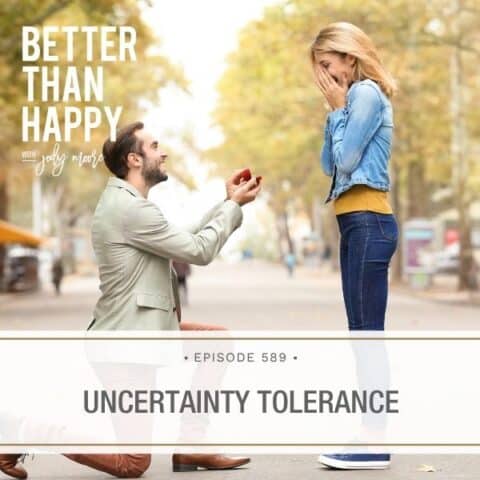
How much of your life are you willing to leave uncertain? Whether you’re starting a business, pursuing a goal, navigating relationships, or trying something new, not knowing how things will turn out can make it tempting to play it safe. But the more you need a guaranteed outcome before taking action, the more you may limit what’s possible for you.
In this episode, I’m talking about uncertainty tolerance and why it plays such an important role in our ability to achieve our goals. I’ll share six strategies for becoming more comfortable with the unknown, and I’ll also explain how we can help our children develop these skills so they feel more capable of navigating life’s uncertainties.
Tune in this week to learn how to take risks without needing guarantees, work through the fear of things not going as planned, and recognize that you can handle more uncertainty than you might think. These tools can help you pursue what matters to you while building confidence in your ability to figure things out along the way.
Better Than Busy is coming back in January of 2027. Sign up now to learn how to create a life that’s better than busy, and to receive the amazing bonus planner so many of you are dying to get your hands on!
What You’ll Learn on this Episode:
- Why uncertainty tolerance can influence how much you achieve in life.
- How to have compassionate conversations with your fear instead of shutting it down.
- Why finding joy in the process makes uncertain outcomes easier to handle.
- How to experience disappointment without letting it stop you from trying.
- Why it’s important to understand what you’re willing to risk and lose.
- How making peace with worst-case scenarios can help you feel more capable.
- Ways to help children practice critical thinking and become more comfortable with uncertainty.
Mentioned on the Show:
- Call 888-HI-JODY-M or 888-445-6396 to leave me your question, and I can’t wait to address it right here on the podcast!
- Come check out The Lab!
- Follow me on Instagram or Facebook!
- Subscribe to Jody Moore Coaching on YouTube
- Grab the Podcast Roadmap!
Episodes Related to Uncertainty Tolerance:
- 577. How Successful People Make Decisions
- 580. “Don’t Worry” Is Terrible Advice
- 584. How to Get Unstuck

As a coach and an entrepreneur and a woman who has some ambition and some dreams and some goals, I get to work with and be surrounded by a lot of people who are achieving extraordinary levels of success. And some who are not. Some who are stuck, or giving up, or failing. And I have noticed one thing that separates successful people from those who are stuck or not achieving is uncertainty tolerance. Someone’s ability to tolerate uncertainty has a direct proportional relation to how much they achieve what they want to in their life.
So today, I’m going to teach you how to increase your uncertainty tolerance and how to teach this to your children or anybody else you have influence over that might be better served by increasing their uncertainty tolerance. Welcome to Better Than Happy, I’m Jody Moore, let’s go.
Welcome to Better Than Happy, the podcast where we apply all the tools of psychology, human behavior, and mindfulness to live our best lives, navigate challenges, and achieve our goals. I’m Jody Moore and I’ll be your coach today. Let’s do it.
Hey everybody, welcome to the podcast. This is such an important topic. I think about it all the time. I’m talking to all my friends about it right now. I’m coaching on it a lot. And I guarantee it’s something that if it doesn’t impact you today, it will down the road if you don’t pay attention. Now, that doesn’t mean you need to be freaked out or scared or worried that your kids are going to be a mess. That’s not what I’m saying. I just think a little bit of awareness goes a long way when it comes to our intolerance for uncertainty. I want to increase your uncertainty tolerance, and that’s why I’m recording this episode.
Now, if you’re listening to this on a podcast platform, welcome. I’m glad that you’re here. But also, you’re missing out on my haircut. I got a haircut. So not for that reason actually, but for other reasons, I want you to go check this out on YouTube because I’m going to start using more visuals. I’m going to start drawing on my whiteboard sometimes. And I just want to use the technology that we have to really bring these concepts to life for you. So a podcaster, which I was for a long time in terms of being a consumer. I listen to podcasts. I’ve switched over to watching videos because even though sometimes I’m on my walk and I’m maybe not watching the video, I like being able to look at it at times and get that visual learning component as well. So go find us on YouTube. Subscribe to our channel. If you’re watching this on YouTube, hi. Thanks for being here.
Okay. So this uncertainty tolerance topic that I chose is largely because in the last couple years, I really started noticing in my kids how intolerant they are of uncertainty. I first noticed it a couple years ago after we moved here to San Diego. We were new in the area. And so I was everywhere we went, I was putting it into the GPS and it was on the screen in my car. So everyone in the car could see the map of where we were going, the step-by-step directions, what’s going on with traffic, and what time it believes we’re going to arrive, right? What a world we live in. It not only gives you directions, it says in the bottom, arrival time, and it gives you an exact time down to the minute. Now, is it always accurate? No, but pretty darn close. Pretty darn close. It accounts for traffic. I don’t know, maybe that thing updates as you go, but still, it’s pretty darn accurate, right? In terms of when you’re going to arrive.
Well, after we’d been in San Diego and I started to learn my way around a little bit better, I didn’t always have to put in the map anytime we were going to Target or school or church or wherever we were going. I started to learn my way around. So I stopped putting it in the map. And that’s when my kids started asking me what I thought was a very bizarre question. They started asking me, what time is it going to be when we get there?
And at first I thought, why would you ask me that in that way? It’s such a weird question. What time is it going to be when we get there? Like, I remember as a kid going, are we there yet? Are we almost there? How much further? Right? Because I was impatient too. But they asked it in this specific way. What time is it going to be when we get there? And I remember going, how could I possibly know that? I mean, I can kind of guess it’s about 10 minutes away, but then you do the math, child. And I realized the reason they’re asking that is because that’s what they’re used to seeing on the screen in my car. That’s what the GPS tells them. It’s going to be this time when we get there. They didn’t ask how many stops do we have? Are we going anywhere else? They just said, what time is it going to be? Or we would be leaving, we hadn’t even left the house yet and they’d say, what time is it going to be when we get home?
And again, I’d kind of think, what a bizarre question. How would I know that? I don’t know if we’re going to hit traffic. I don’t know how long we’re going to be at dinner. There’s so many things I don’t know. Well, my kids were just responding to the world I was raising them in, right? They got so used to knowing what time it was going to be when we got there that’s what they preferred. They could then mentally prepare accordingly. They could maybe let their friends know what time they were going to be home and that they could get back online to play Roblox on their iPad. They had to guess how much time they were going to have before they had to go to bed after they got home, right? They wanted to prepare usually mentally, but sometimes in other ways, by knowing what time it was going to be.
So, okay. I mean, nothing wrong with that, but I didn’t have that luxury growing up. Neither did you probably, right? We just had to make accommodations accordingly. Which is the part I worry about a little bit, that we’re losing the skill of figuring things out on the fly, of problem-solving in the moment, of figuring out how to create what we want when life doesn’t go how we want. Because sometimes life is going to go the way the GPS says, or the way we thought or the way we predicted, but many other times it’s not. And if we can’t make do, if we can’t figure things out when life doesn’t go according to plans, that’s a problem. Not only is it a problem in being able to achieve your goals, it’s a problem in just feeling good in the world, feeling safe in the world. I want you to know that you’re capable of making adjustments, of finding solutions, of problem-solving, even when things don’t go how you hoped they would go. Okay?
Now, GPS isn’t the only thing doing this to us. Amazon and their freaking amazing service is doing this to us, right? Remember when we were kids and we would send in the thing off the side of the cereal box, we’d mail it in to get the toy, and then it said it will take about six to eight weeks. And then we would just wait around and then halfway forget about it. And then one day it would show up in the mail and we’d be like, “Oh yay, that toy I ordered a lifetime ago.” We don’t do that now. We get on Amazon. Before we even order it, it tells us, if you order this now, it’ll be here on this day. It even gives us oftentimes a delivery window of a couple of hours. I get on Amazon and it says, “Order this now and get it today between 3:00 and 5:00 p.m.” It’s insane how fast it is. And it’s pretty accurate, right? It’s not 100% accurate, but it’s pretty accurate.
Now, here’s the other thing my kids have been asking me. I’ll go to pick one of them up from school or some place and they’ll say, “Can I see your phone?” I’m like, “Okay, why?” I need to look on Amazon. “I need to see if my package is out for delivery. I need to see how many stops away my package is.” Are you kidding me? Yeah. They can get on there, right? Myself, I do the same thing. This isn’t about accusing my kids of doing it wrong. I’m just saying this is the world we live in. I get on there it says, your package is five stops away. I can even sometimes watch in real time the driver of my Amazon delivery. I can see on the map where he or she is and when they’re going to be here with my package. Holy cow. I do not have to tolerate a lot of uncertainty anymore if I order something online.
Now, this is a beautiful thing when it comes to getting online packages. It’s a real problem when I want to go live my life in a big way and try things and do things and experiment and I’m not used to having to tolerate uncertainty. My brain doesn’t like it. Why do our brains not like it? Because uncertainty equals danger in your brain’s mind. Possible danger, right? If we don’t know what’s going to happen, if we don’t know what the result is going to be, it could be tragic. It could be bad. It could be hard. In fact, it could be worse than where we are right now. We should just not try things. That’s what the brain says. We’re fine right now. We’re perfectly content. We’re perfectly safe. Why try something that could result in something worse than where we are right now?
So what’s the answer to that? Why? Why try things that you don’t have a guaranteed result on? Because that’s the way you live your best life. If you’re not willing to take some risks, you’re going to shrink your life. I notice as I age, my brain seems to want to be less comfortable with uncertainty. It’s like, I don’t know, that could be scary. That could go wrong. Someone could get hurt. Someone might have their feelings hurt. That might be just more difficult than you think. You might be tired. And those are just minor things, right? Then there’s all the major things where I’m pretty sure somebody’s going to die that I love. And the brain doesn’t like that. I would rather everybody just stay in their houses where they’re safe, not do anything uncertain, so that I don’t have to worry about everyone or myself, right? That to me feels like the tendency my brain is trying to take me in. I don’t know if it’s an age thing. I don’t know if it’s again, the world we live in and I’ve gotten worse at it. All I know is it’s not serving me.
It’s not a great way to raise my kids because if every time one of my kids tells me about something they want to try that’s uncertain and my brain is scared, I’m going to try to talk them out of it. And eventually they’re going to learn, “Don’t share your dreams with mom because she’ll squash them.” Hopefully, they’ll keep having dreams, but they’ll stop sharing them with me. That’s not what I want for my relationship with my kids. I want to be their biggest supporter. I want to be their cheerleader. I want to be their fan. So I have to manage this in my own mind.
I have to understand that uncertainty is part of the game of life. It’s just part of the deal. It’s part of being a human being. There are no guarantees. You get married, there’s no guarantee that’s going to be happily ever after. Even if you date the person forever and think you know them very well, people change. Surprises come along, right? You’re going to start a business, there’s very little certainty there. There’s so much uncertainty, right? You’re going to try things. You’re going to you want to go on a serve a mission, you want to go away to college, you want to have children? Welcome to uncertainty. We don’t know how any of it’s going to play out. We could make what we think are all the right decisions and the best moves, and that doesn’t mean anything’s going to turn out how we think.
If we learned nothing from the pandemic, we should have taken this away, that there is no certainty. We don’t know what’s going to happen in the future. And I don’t mean this as a doom and gloom message. I don’t mean everything’s just going to get worse and go wrong and be bad and you should brace yourself. I mean, sometimes things are going to be more amazing than you ever anticipated. Sometimes things are going to work out in a way you never could have predicted. And sometimes you’re going to have moments of joy and happiness you never saw coming. What I’m saying is that uncertainty is a part of life, and the more you tolerate it, the bigger your life gets.
Are you with me? All right. So how do we nurture in ourselves a tolerance for uncertainty? And how do we nurture it within our kids or our loved ones? That’s what I’m going to dive into today. I’m going to give you six strategies to consider, okay? I want you to execute any of these that feel like, yeah, I think I could do that. I don’t want you to push yourself over the edge. I don’t want you to become overly anxious. I don’t want you to think that there aren’t chemical, by the way, and hormonal things that can impact this. If you have some kind of wiring in your brain that you think might be OCD or something like that, I want you to get help from a clinical therapist. That is not me. That’s outside my pay grade, okay? Those are real conditions and real things. But I do think even along with treatment like that, these strategies could serve you. And certainly for the average person, this uncertainty tolerance is available to you and will serve you to increase if you execute even just one or two of these six strategies I’m going to give you.
All right, first thing, learn to have compassionate conversations with your own fear. Learn to have compassionate conversations. Conversations. That means you listen. Important part of conversations is listening. Some of y’all, sometimes I could work on that part of conversations, right? But it’s not just an interrogation. It’s not a shutting down. It’s not saying, no, don’t think that. Don’t be afraid. You shouldn’t worry about that. You’re not supposed to think this. That’s not a conversation. That’s a shutting down of your fear. If it works for you, great, do it. I find mostly it doesn’t work. What you have to do is have compassionate conversations, okay? So it sounds like this. “Oh, hey, yeah, we’re going to try this thing. And yeah, it might not work.”
Like, let’s say you’re going to try out for some kind of position. You’re going to apply for a job, let’s say, okay? And your brain’s like, “Oh, this is scary. We’re going to send out all these applications. We might get rejected, or we’re going to go to these interviews and you might get turned down and it might not play out how you want.” Okay? That’s your fear talking. So I like to picture my fear as a little girl version of myself. She has pigtails. She’s very cute, but she’s very shy and she’s very scared, which is exactly what I was like as a little girl, okay?
And I just say to her, “Oh, hey, Jody, what’s going on? What are you afraid of? What are you really worried about? Okay, so you’re going in for this job interview or you’re going to apply for a job and you’re scared. All right, that’s okay. That’s valid. Tell me why. What are you really afraid of? Say more.” Because the thing is whatever your fear presents itself as is probably going to be a really vague and ambiguous statement that’s hard to understand.
Like I just had a woman the other day on one of my calls say, “I’m afraid of succeeding.” Okay? She’s a coach building a business. She’s like, “I’m afraid of being successful.” I’m like, what do you mean by that? People say that all the time. I’m like, okay, say more about that. Tell me what would success look like in your mind and what are you really afraid of? As we answered these questions and had a very compassionate conversation.
By the way, she wanted to judge herself. She wanted to go, “I know, that’s ridiculous. I shouldn’t worry about that right now. I know this doesn’t make any sense.” I was like, “No, no, no, no. That’s not what we do in a conversation. Every time the other person speaks, if you go, ‘That’s ridiculous. You shouldn’t be saying that. This doesn’t make any sense,’ then you don’t have a conversation. You have an argument.” Okay? And I’m not telling you to argue with your fear. I’m telling you to genuinely have a conversation. So, “Oh, okay, say more about that. Well, what do you mean by that? Huh. Okay, interesting. That’s okay that you’re worried about that. It’s valid. But also, it doesn’t exactly make sense, right?”
Like this particular client was worried that she was going to neglect other parts of her life and she wasn’t going to have the time. This is often what I hear when people say they’re they have a fear of success. Not always, but often. It’s I’m afraid I’m going to abandon every other part of my life and my relationships or my family obligations or whatever are going to fall to the wayside if I have so many clients in this thriving business. I’m like, okay. Well, this is understandable, right?
Now, let’s explore it though, because you say that as though you don’t have the ability to choose how you’re going to spend your time. As though you would be like a puppet and a puppeteer is moving you around forcing you to spend all your time on your business and not be with your family. But that wouldn’t be the case. They would be your choices, right? And you always get to stop and reassess and evaluate how you’re spending your time. And if you have so many clients that want your help, you can’t get to them all. This is a great problem that we could solve. There’s lots of solutions, lots of options. You could turn away clients. You could say, “I’m booked.” You can limit how many clients you’re taking. You could hire other coaches to coach for you. You could go to groups, you can scale. There’s so many solutions to this problem.
But what you’re really afraid of, it sounds like, is not having work-life balance or not spending time with your family and the things that are important to you. Is that what you’re saying? Okay. Let’s remember that’s a choice. Let’s commit to ourselves right now not to do that. Let’s put a limit on how many hours we work and not violate those boundaries. We can start there right now if we want. Right? So when you have a compassionate conversation with your fear like this, you’re going to understand what’s really going on. And again, you could then offer yourself some alternative thoughts or solutions, but it often helps the fear subside when you hear it out. When you hear it out, when you validate it. “Okay, I love that you’re thinking about this. I love that you don’t want to neglect your family. But also let’s remember A, B, C.” Okay? So that will help increase your uncertainty tolerance.
Number two, practice finding joy in the small things. Now, you might be thinking, “What are you talking about? How does that increase my uncertainty tolerance?” Let me tell you how. Let’s say, let’s talk about with your kids, by the way. I’m going to use a kid example this time because this is how I would talk to your kids if you want to help them increase their uncertainty tolerance, okay? It let’s say they’re going to try out for the basketball team, but they’re afraid they’re not going to make it. Right? That’s intolerance for uncertainty right there. It’s like, I just can’t do it because if I don’t make it on this team, I’ll just be so heartbroken. So I’m not going to try out for the team, guaranteeing, by the way, that we don’t make it. We call this failure ahead of time. And it’s because of uncertainty intolerance.
So what we would do is be like, okay, listen, let’s go back to finding joy in the small things. Can you enjoy the process of trying out for the basketball team? What might be enjoyable about it or cool about it or useful for you about it, even if you don’t make the team? Are there benefits to just trying out? Now, if the child can’t see them, you help them see them, but you do the same thing with your own self and your own brain when it’s afraid, right? What might be the benefits of trying out even if I didn’t make it?
Well, I would get to go play basketball a little bit because trying out probably includes some playing of basketball, right? I might get to meet some people that I wouldn’t otherwise meet. I get to be there for myself and learn what it’s like to get my own back. I get practice doing something hard and scary. I get practice being vulnerable. Like all of these things are very useful. And again, I would be looking for also what would be fun about this process? Can you lighten up and have fun with it? Have fun trying out so that if you don’t make it on the team for some reason, at least you had fun up until that point. And you can be proud of yourself and you can take away a lot of valuable things, a lot of connections or experience.
So I find that people who are good at doing this are willing to take more risks because they don’t make the end result, which is uncertain, so heavy. It’s not like I have to get that result in order for this to be worth it. No, I’m making it worth it along the way. And so the result doesn’t become as important, which ironically enough, makes it more likely I get to the result.
Isn’t this crazy? Like if you’re going to try to find a spouse, let’s say. Maybe you’re you’re single and you’re dating and you want to meet someone. Well, dating is full of uncertainty. I don’t know who I’m going out with. I don’t know if I’m going to like them. I don’t know if they’re going to like me. What if I fall in love and they reject me? What if they fall in love with me and I have to reject them? What if we get married and it doesn’t work out? What if they’re not who I thought they were? Full of uncertainty dating, right?
So, brain doesn’t like that uncertainty. But if we’re just like white knuckling it because we really want a spouse, it’s a tough way to go. But if you’re like, listen, yeah, yeah, I want to get married if that’s what you want. I’m going to find someone. That’s going to be cool. That’s going to be fun. But meanwhile, how do I have fun with the process? How do I make it more fun? How do I just enjoy finding the humor in all of these crazy bad dates I’m probably going to go on?
How do I enjoy just getting to know someone and appreciating someone, something about them even if I don’t want to keep dating them? How do I take care of myself if somebody rejects me and I find I need a little extra comfort and support? How do I get that for myself or provide it for myself? How do I just find some joy in the process so that no matter what the outcome is, I’m glad I did it? I get the benefit of doing it because there is benefit in doing it, whether you see it or not. But if you stop and try to see it, you’ll get more out of it, but it also increase your tolerance for the uncertainty because it’s worth the risk anyway. It’s worth the journey. It’s worth the process.
Are you with me? So this is, again, how I would advise my kids is the same way I’m talking to my own brain, you guys. I would say, hey, what are you really, back to number one, what are you really afraid of? And we have conversations about it and I validate it and it’s okay. I make it okay to be afraid. But I offer them some alternative thoughts or I offer them, you know what would be cool about trying out whether you make it or not is this, that, or the other thing. Or I ask them, what would be cool about trying out, whether you make it or not?
Okay. Number three, get better at disappointment. Get better at disappointment. How do we get better at disappointment, Jody? And why would anyone want to get better at disappointment? Don’t we don’t want to just avoid disappointment? No. If you have to always avoid disappointment, you’re going to shrink your life significantly. Not in a good way, my friends.
So, get better at disappointment and understand disappointment. I’m keeping both of those lumped together here with number three, but I want to speak to them separately. You know how you get better at disappointment? You just be disappointed. You notice that you’re feeling disappointment and you say, oh, I think I’m feeling disappointed right now. Now, what does that feel like again? And you get in your body and you open up to it and you try to experience it. You relax into it. You take deep breaths. You go, oh, I feel it. It’s right there in my throat, or it’s in my chest, or it’s in my stomach. It’s probably in one of those three places right here.
It’s kind of tight. It’s kind of a pressure. Or maybe it’s making me want to cry, depending on how strong it is. But this is what it’s like to be a human being living in a body on Planet Earth, having thoughts, is sometimes I create this emotion that I’m calling disappointment. And it’s okay. I can be disappointed. It’s not going to kill me. It’s not really even that big of a deal. I’ll just be disappointed, I guess.
Meanwhile, I’m going to be loving on myself. I’m going to be holding myself, whatever that looks like for you. Maybe it’s like literally climbing in bed for a minute, taking a nap. Maybe it’s going for a walk, maybe it’s calling a friend. Maybe it’s taking a half a day off from whatever you normally do to do something more pampering and relaxing and de-stressing. What are you going to do? How are you going to do disappointment?
If you open up to it and relax and take care of yourself, I don’t mean that you wallow in it. I don’t mean that you run away with all the thoughts. I mean, be in your body and be there for you and support you. And guess what you’ll find? It doesn’t even last very long. It goes away pretty fast. Like sometimes it’s just a good cry is all I need.
Now, also, I want you to understand disappointment. Disappointment is an emotion that is not created by what did or did not happen outside of you. It’s created by the thoughts you’re thinking inside of you. Okay? So somebody not offering you the job doesn’t make you feel disappointed. Your thought, oh, I really wanted that job. I thought I was going to get that job. I wish I would have gotten that job, makes you feel disappointed.
Now, do you see why I started with get good at disappointment? Because it’s okay to think those thoughts. It’s understandable at times. It’s human. It’s part of your life experience that you’re going to want to think and believe those kinds of thoughts at times, which means you just allow the disappointment. But there are times, other times when you decide, I don’t need to be disappointed about this. This is actually not disappointing.
Like I see this happen with entrepreneurs all the time. They say, I just want to make 100k in my business. And they work really hard and they hit that 100k mark, and they come to a call and they’re disappointed. I’m like, what’s going on? Well, it just took me so much longer than I thought it was going to. I should have done it long before now. I’m still behind. My friend who started the same time as me is now making a million dollars and I just hit 100k. And I’m like, okay, but if you want to be disappointed, you can, but I think we should question it this time around.
I think you could, if you wanted, be very proud of yourself. You could change your thoughts. You could decide it’s not a race and you don’t need to be in a rush. And that it’s not better there than here because there are just different problems at a million than at 100k. Yeah, different benefits too, but different problems. Still 50/50 either way.
So there are times when I stop and go, wait a second. Do we really want to be disappointed about this? I do that with my own self and my own brain. I do it with my clients all day long. So I recommend you number one, get better at disappointing and number two, understand it. Now, let’s talk about with your kids.
If I have a kid who’s disappointed, I say to them, oh, this is disappointment. I’m so sorry that you’re feeling that way, but it’s okay. It’s okay. I feel disappointment sometimes too. Right? If appropriate, again, it depends on the child’s age, but I might credit it back to what they’re thinking. I might say something, oh, you’re thinking that you really wanted that to happen and that’s why you’re feeling disappointed and that’s okay. Take a deep breath. Deep breaths in and out. I’m so, again, I’d say lots of, I’m sorry you feel that way, but also it’s okay. You can just take some breaths and relax.
I’m disappointed because I’m thinking I wish my kid wasn’t disappointed. So I’m going to do disappointment with you. I’ll do it with you. Let’s do it together. What do you want to do? Do you want to go for a walk with me? Do you want to talk about it? Do you want to not talk about it? I’m here for you. What can I do to help you move through this disappointment? But meanwhile, it’s okay to be disappointed. Okay?
This is, by the way, useful when they want something. They want money, they want to buy something and your answer is no. And they’re pouting and sulking, you’re like, I just sometimes say, oh, we’re going to get good at disappointment right now. It’s okay. All right. Be careful with that one. Don’t get sassy like I just got. Okay. Also then, again, sometimes I will point out their thoughts and maybe offer them new thoughts if I think this is a situation where we don’t really need to be disappointed.
All right. Number four. Yes, I want you to increase your uncertainty tolerance, but I don’t want you to risk more than you’re willing to lose. Okay? So, sometimes I teach stuff like you can think whatever you want and whatever you think and believe you’re going to create in your result line. And people say that’s very irresponsible of you to tell people, Jody, because what’s to keep someone from saying, I believe I if I jump out this window, I can fly, and then they injure themselves.
And I say, well, I’m talking about thoughts you genuinely believe, not thoughts that you don’t believe, but I see where people are going. We like to go to extremes, right? To make a point sometimes. So what I recommend is that you don’t risk more than what you’re willing to lose. Now, this might be financially, right? You might be like, hey, I’m going to try this thing in my business. So I’m going to invest in this coaching program or I’m going to invest in this marketing strategy or I’m going to invest in this, I don’t know, online platform or something. And I hope it yields me what I want. I hope it gets me the clients I want, or maybe you’re investing money in the stock market. There’s some uncertainty for you, right? I’m going to put money into this stock and I hope it yields me a return in the end, but who knows? It might be a loss at some point. It might be a bad investment, right? So do not invest more than you’re willing to, “lose.”
We have to say that in quotes because what does that even mean, right? I mean, you could stay in the stock market. If you stay long enough, you always win. I think is what they say, right? If you got somebody that knows what they’re doing, but also even in my own business. So sometimes I think I’m going to invest, I’m going to put money into ads, for example. I’m going to increase some marketing spend here. And I don’t know if that’s going to pay off right away or ever, really, but I’m not putting more money in than I can afford to not see a return on in the future, right? Like if I’m like, I’m going to second mortgage my house so I can run ads. No, that’s not what I’m talking about. I’m not willing to lose my house over this risk.
Okay, now that’s where, again, this is personal because some people are higher risk tolerance. I’m not talking about risk tolerance necessarily. I’m talking about uncertainty tolerance. Yes, there’s some overlap, but it doesn’t just have to be financial either. Let’s talk about other examples. I will go on a roller coaster even though there’s a little bit of uncertainty, right? Like the ride could break down, something could go wrong and that could go very badly. But my thought is the odds of me really dying on that roller coaster or getting severely injured are low enough. More likely what would happen is it would be very inconvenient. If I got stuck on a roller coaster for hours and they couldn’t get me off, that’s a risk I’m willing to take. It’s a risk I’m willing to take, right?
There are other things though that, in my opinion, these are all just thoughts. These are all just thoughts. In my opinion, have a higher potential risk, like motorcycles or other certain extreme things that people do that I’m like, I don’t know, according to what I’ve heard and learned, the likelihood of a tragic accident is pretty high on certain things. I’m not willing to risk that. I’m not saying you shouldn’t. I’m saying, don’t risk more than you feel comfortable losing.
Okay? So if I invest some money in ads and I don’t get the money back right away, is that okay? Yeah, it’s okay. Because I’m going to learn some stuff. I’m going to progress and I probably at least will have gotten in front of some people. Maybe that pays off down the road. Who knows? I’m willing to, “lose” that money. I don’t think it’s really lost, but maybe we want to call it that in the short term. See what I’m saying? So don’t risk more than you’re willing to lose.
Now, again, if I’m talking to one of my kiddos or something about this, I have this come up because I have two kids in college. So they’re making lots of decisions right now about jobs and school and, you know, different situations and they’re coming to me sometimes saying, I’m thinking about trying this thing, but it will cost me this much money and I don’t know, what if it doesn’t play out in this way? And I’m helping them think through. Okay, well, you know, are you comfortable with, “losing” that money if that happened? Can we just for a minute make peace with it, which actually goes to number five.
So let’s just go to number five, make peace with worst-case scenario. Okay? And this is how we figure out how much we’re willing to lose. So if my child’s going to invest money in something and they’re worried they’re not going to make money on the other side of it, I say, if you didn’t make money, if you, or if you could at least couldn’t see a direct correlation to the money you make off of that thing, would you be okay? Yeah, I’d be okay. Okay. Still going to be able to pay your rent? Still going to be able to eat? Still going to be able to pay your bills? Going to be able to go out and make more money? Yeah. Okay. So that would be okay.
Now, then we turn it around to, let’s also remember that best-case scenario is possible and what’s likely is something in the middle. And so maybe this would be a great opportunity to learn and grow and try some things. But when you make peace with worst-case scenario, you will be comfortable with more uncertainty.
I remember figuring this out years ago. I had two kids at the time. They were little. They were in elementary school. And we had a car that liked to not start. Okay? So I would say probably one out of seven times, I’d go get in it, turn the key, nothing would happen. Okay, we took it into the service shop so many times. And of course, every time we took it in, they couldn’t recreate the problem. So they couldn’t fix it. They couldn’t figure out what was wrong. I started getting on the internet, onto YouTube and finding other people who had this same car, saying they were having this same problem, and nobody knows how to solve it. Okay? So we were not in a position to buy a new car at the time. I was just like, I don’t know, I’m just going to have to know that sometimes this car is going to start and sometimes it’s not.
And my biggest fear at the time was that I was going to be somewhere far away from my kids’ school and it was going to be time to pick them up and my car wasn’t going to start. And I wasn’t going to be able to get there because my kids were deathly afraid of me not picking them up from school. I don’t know why. I never once forgot, but that was just something they were nervous about. They’re like, Mom, you’re going to be there, right? If I was even a little late, if I wasn’t standing in the right spot at school pickup, they would have a meltdown and start crying. So the last thing I wanted was to not show up for school pickup. Now, these were also little kids. They didn’t have cell phones where I could give them a heads up if I wasn’t going to be there, right?
So I started to have this fear. Oh my goodness, this could happen. It’s possible that I could not make it to the school to get my kids and it might take me a while and I might have to get a message to them somehow, right? So what I did was I just said, I have to make peace with worst-case scenario. Make peace with worst-case scenario. So I played it out in my head. What if I’m at Costco, which is pretty far away from the school? And I’m in the parking lot and my car doesn’t start. And it’s, I have just enough time to get to the school. Okay, well then there are options. There are solutions, there are things I could do, right?
I started brainstorming. I could call the school and put a message in. I could ask someone to watch for them. I could call another parent I know. I started playing out all the options. I realized I could, you know, figure out how to get a ride to wherever I need to go. Eventually I’d get to them. I wasn’t worried my kids were going to be in danger. It was just the meltdown. So as I played out in my head, not exactly here’s what I will do, because I don’t know where I’ll be if my car doesn’t start. I don’t know exactly what might happen. I just tried to make peace with what seemed like worst-case scenario in that moment according to my brain, what I was really scared of.
And then I did the same thing for my kids. I said, hey guys, listen, I’m going to pick you up. I’m very certain of it. Now, is there a chance something could go wrong, like my car doesn’t start or something, and I can’t get here on time? Yes, you’re right. That is a possibility. That is something that happens in the world. And in fact, our car right now is not all that reliable. So then I helped them make peace with worst-case scenario. What could you do?
And this actually brings me to number six, which is practice critical thinking. Practice critical thinking. My kids were little at the time. Like I want to say first and second grade or something, maybe even kindergarten and first grade. Okay? So instead of me saying, you could do A, B, C, D, I said, okay, guys, here we are. I did, I remember doing this after school. Like they came out of their classrooms, they found me and I said, hey, for just a moment, let’s imagine that I wasn’t here for some reason. I’m not telling you that’s likely, but it is possible, right? If you walked out here and I wasn’t here, just stop for a minute and take a look around at what’s happening around us, kids. What could you do?
And if they couldn’t figure it out, I helped them a little bit, right? They had some guesses. I said, hey, you see that teacher standing right there? Can you tell that’s a teacher? How can you tell even though that’s not your teacher, how can you tell she’s a teacher? Oh, she has a lanyard on and a badge and I’ve seen her on the playground. Right. There’s also somebody who appears to work for the school because she has like a kind of a traffic vest on. It seems like she’s directing traffic, right? Could you go talk to her? Yeah, okay. What else? What if you didn’t see a teacher? You didn’t see whatever they’re called, after school helper person? They said, oh, there’s the office. Yeah, there’s the office. The office is going to be there and there’s going to be somebody in that office, right? What could you do? I could go in the office. I could say, hey, my mom’s not here and I don’t know what to do. They could probably help me, right? Yeah, good thinking, kids. What else could you do? Oh, there’s my friend with her mom. I could go to my friend and her mom and say, my mom’s not here. Can you help me? Right?
So I helped them practice critical thinking and I helped them even at the same time make peace with worst-case scenario. And I helped them see that, wait a second, I would be okay actually. This is the way you get comfortable with uncertainty, is you play out a few scenarios in your mind and even if none of those things were an option, you start noticing that you have amazing critical thinking skills. Now, I know you’re like, that’s easy if it’s not picking my kid up from school, but what if it’s again, I’m trying to get a job. I’m, I’m going to launch this thing in my business. I’m going to propose marriage to someone. I’m going to have a difficult conversation with someone in my life and I don’t know how they’re going to respond. Guess what? Same principles apply.
If you stop and you make peace with what your brain is coming up with as worst-case scenario about that moment. Why are you really scared of that moment? What are you afraid might go wrong? And really hear yourself out. Have a compassionate conversation, right? And then decide what would be some possible solutions or what you could do next. Learn to have fun in the moment. Decide that the process itself is actually useful if that’s true. Right? And again, don’t risk more than you’re willing to lose. You don’t have to. You don’t need to. There’s plenty of opportunities to get comfortable with uncertainty, and worst-case scenario doesn’t have to be something you couldn’t live with.
Okay? All right. I hope this helps you, my friend. Please do me a favor. Hit subscribe, hit follow, and share this with your friends if you liked it. I’ll see you next week on another episode. Bye-bye.
Hey everybody, thanks for listening today. Please do me a favor and make sure you’re following or subscribed to the show if you got a lot out of this and share it with a friend. Make sure you never miss an episode and help me spread the message of mental and emotional health and creating your best life. I’ll see you next time.
Enjoy the Show?
- Don’t miss an episode, follow on Spotify, Apple Podcasts, YouTube or RSS.
- Leave us a review in Apple Podcasts.