Podcast: Play in new window | Download
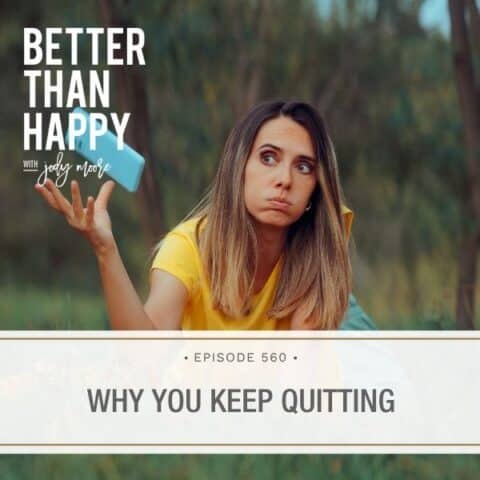
Why do you keep quitting on the things that matter most to you? We’ve all been there: excited about a new goal or project, only to give up after a few setbacks or challenges. But why do we do it? If we’re so committed in the beginning, what causes us to fall off track?
In today’s episode, I dive into why you keep quitting, even when you deeply care about the goal. It’s not because you’re lazy or incapable, but because of how you think about the process and your beliefs about what’s possible. I’ll help you recognize the mindset and patterns that lead to quitting, and how to break free from them.
Join me this week to walk away with actionable insights on how to build better habits, stay committed, and shift your mindset so that you don’t give up so easily. I’ll also share how you can adjust your goals and expectations to make them more sustainable for the long haul. You are capable of achieving more than you think, but you have to change how you think about quitting first.
If you’re serious about succeeding in your coaching business, come to a free business coaching call with Jody by clicking here!
What You’ll Learn on this Episode:
- Why thinking you need to be motivated to take action actually holds you back.
- How believing that “things should be easier” leads to quitting when challenges arise.
- The impact of perfectionism and why it’s sabotaging your progress.
- 5 attitudes that keep you quitting, and how to counter them.
- The difference between wanting to change and committing to change.
- Why setting “good enough” as a goal can be more effective than aiming for perfection.
- How shifting your mindset from “I can’t” to “I will” leads to lasting commitment.
Mentioned on the Show:
- Call 888-HI-JODY-M or 888-445-6396 to leave me your question, and I can’t wait to address it right here on the podcast!
- Come check out The Lab!
- Follow me on Instagram or Facebook!
- Subscribe to Jody Moore Coaching on YouTube
- Grab the Podcast Roadmap!
Episodes Related to Why You Keep Quitting:

What if I could teach you how to make sure that you never again quit on things that are important to you, that you want to make sure you see through to the end? There’s a reason why you keep quitting, and it’s not what you think. And today, we’re going to dive into it so that you can finish out all the important projects in your life. This is Better Than Happy. I’m Jody Moore. Let’s go.
Welcome to Better Than Happy, the podcast where we transform our lives by transforming ourselves. My name is Jody Moore. In the decade-plus I’ve been working with clients as a Master Certified Coach, I’ve helped tens of thousands of people to become empowered. And from empowered, the things that seemed hard become trivial, and the things that seemed impossible become available, and suddenly, a whole new world of desire and possibility open up to you. And what do you do with that?
Well, that’s the question… what will you do? Let’s find out.
Sometimes, listening to a podcast is enough. But sometimes, you’ll feel inspired to go deeper. If you hear things that speak to you in today’s episode, consider it your invitation to a complimentary coaching workshop.
On this live, interactive Zoom call with me, you’ll get a taste of the power of this work when applied in real life. You can participate, or be a silent observer. But you have to take a step if you want to truly see change in your life… two steps, actually. Head to JodyMoore.com/freecoaching and register. Then you just have to show up. Your best life is waiting for you. Will you show up for it? JodyMoore.com/freecoaching. I’ll see you there.
Hey, everybody. Welcome to the podcast. Thank you for joining me today. So, today we’re going to talk about why we quit things, why we quit things, and how to stop quitting the things that we want to keep going on. Now, the two areas where this comes up the most for most people is with relation to our money and our health, right? Those are the two areas where we tend to quit. We quit on trying to eat better, going to the gym, moving our bodies, whatever else is involved in you maintaining or improving your health. We quit on building our businesses, posting content, doing marketing, job searching, saving money, investing money, whatever it is that you’re trying to do to meet your financial goals. Those are the two areas it comes up most often.
Sometimes it’ll come up in our parenting, right? Maybe we have a really great strategy for our kids in terms of chores and we’re really organized and we’re going to execute it. And this time we’re going to hold them accountable, and then how long does that last? Not as long as most of us wish it did, and then we quit. Or any other number of habits you’re trying to execute: reading more, watching less TV, going to bed earlier, right? All of these things that are little things in the beginning but add up to big results sometimes in our lives. And I love the saying, I don’t know who first said it, but “things that are easy to do are easy not to do.” It’s so easy to quit on these things.
But today I’m going to tell you there are three reasons why you keep quitting. So I want you to pick one area of your life that you can apply this to, and I want you to just try on each of these reasons and see if they don’t apply and how we can use this information then to get you to follow through. Are you ready? Let’s dive right in. The first reason that we quit on things is because of our beliefs. Okay? What you are believing will impact whether or not you will continue on. And this makes perfect sense. So, the first thing you have to believe is that it will work. If you don’t believe that it will work for you, if you don’t believe that the effort you’re putting in is going to result in the payoff you want to have in the end, you will quit, as you should. Why would you keep doing something that you don’t believe is going to work? I wouldn’t want you to do that. It wouldn’t make any sense.
Okay, so this is a tricky thing because most of us when we go to start something new, let’s say I decide I’m going to really focus on my health. I’m going to get healthy and I’m going to reverse my insulin resistance. I’m going to make sure I don’t end up with type two diabetes. I’m going to end up insulin sensitive in the not even the pre-diabetes category where I was for a long time personally, but back to normal regulated glucose in my body.
So I might gather all the strategies in the world and go ask people, “How do I do this?” Not wrong to do that. But if I don’t believe it will work for me, I’m probably going to quit at some point. I can override my non-belief for a little bit, but eventually, it’s probably going to be hard, right? We don’t quit on things that are easy to do. We quit on things that are hard to do. Why are they hard? Because we have to forego pleasure, we have to endure pain, we have to be patient, we have to not see payoff, we have to sacrifice immediate gratification for long-term results. The brain doesn’t like that at all. Your brain will try to talk you out of that at all costs.
So, if you don’t believe it’s going to work for you, you will quit. Now, what if you kind of believe it maybe could work? You believe other people when they say it’s worked for them. You believe the experts when they say this works for most people. You’re just not 100% convinced it could work for you. You want to believe it could work for you. Part of you even does believe that it could work for you, but not enough of you to keep you going. That’s okay. But you have to keep nurturing your belief. You have to work on strengthening your belief that it could work for you. You can start by looking for evidence outside of you. Look at how it’s worked for other people and notice the similarities that you have with them.
Your brain will try to do the opposite. It will go, “Well, you’re not like them.” Because remember, your brain doesn’t want you to forego immediate pleasure and tolerate immediate pain in the name of long-term payoff. It’s not sure that long-term payoff is really coming, so it just wants you to care about the here and now. So, it will try to point out to you that they’re different than you. That might have worked for them, but it’s not going to work for you. That’s just your primitive brain. Okay? It thinks it’s doing right by you, so we’re not mad at it. We’re just not going to let that part dictate how we’re going to live our lives.
Because the truth is, these are people who have a lot of similarities to you, and there could be more of them if you’re on the lookout for them, and you can use them as proof that it could work for you as well. And if you keep nurturing that belief, and at some point, you could even just choose to believe that either this is going to work for you or you’re going to find another way, and you’re just going to keep going until you find the way. You’re not going to quit. You’re going to commit to keeping on going. That is enough. That is enough. Okay?
So, the second belief that will get in your way is that it’s just not really necessary. This is one that comes up for me a lot, just to be vulnerable. Okay? So I go through waves of being really good about being active and moving my body and lifting weights, and then I go through phases of like, “Oh, life just got busy or I got tired or whatever,” and I’m not moving my body as much. I’m not lifting enough weights. I’m not even getting enough steps in sometimes. And it’s tempting for me to believe it doesn’t really matter that much because, you know what? I kind of feel the same. I haven’t even gained any weight. I kind of look the same. It doesn’t seem like that big of a deal that for the last month, I’ve kind of been a lazy slug. Maybe it doesn’t matter that much, right? Because we’re talking about things that take a long time to see the results of usually, in most cases, right?
Or maybe I do start doing it. Maybe I am moving my body more, I’m eating better, or whatever, and I don’t feel better. In fact, I feel worse first, right? I don’t look any different. I’m not losing weight. The scale’s not going down. So maybe this doesn’t actually matter. So that’s the second belief that will get in the way. It’s not really necessary. So, for this one, you have to think longer term. You have to lengthen your lens. Okay, maybe it doesn’t matter this month. Maybe it won’t even affect me this year. But there are compounding effects over the long term, for better or for worse, right? From the small everyday actions. Sometimes for me, I like to rely on, “I just want to be a person who does this because it seems like a healthy thing to do,” even if I could go the rest of my life not lifting weights and it wouldn’t really negatively impact me. I still want to be a person who did what I could to be strong. I want to be someone who lifts weights. I want to be someone who moves my body, right?
Now, again, you can relate this to any area of your life. Let’s say it’s with your kids, right? And trying to hold them accountable to doing their chores. If you keep quitting on that, you might have all your reasons why, like you want to teach your kids how to work hard, you want to teach them to be accountable. You want the help around the house. I find that holding kids accountable to chores is harder than just doing the work myself, but that could be a motivation for some people, right? So if I quit doing it and notice it doesn’t seem to matter. They seem to have the same work ethic for better or for worse. They seem to have the same attitudes. Or I start doing it, and they get grumpier and our relationship gets harder. My brain might think, “This is not really necessary.” And I’ll start looking out for proof of that, right? I’ll look at other people who say, “You know what? I never had my kids do chores and they turned out just fine. They’re actually doing amazing and they work hard and they understand how to clean the bathroom, and it wasn’t a problem at all.” And I will start collecting evidence that it’s not necessary.
Now, don’t get me wrong, you can change your mind at any time. You can decide this isn’t necessary and I don’t want to pursue this thing. But if you’re going to look back and say, “I quit on that thing,” and “I wish I hadn’t quit,” and if you’re going to feel bad about it, then you have to change your beliefs. You have to decide that this is necessary. This matters. Now, that sounds like the opposite of the advice I often give out because I like people to take the pressure off and take the heaviness off of things. But if you don’t believe on some level that this matters, that you are taking care of your future self or your family’s future or some kind of future, and you don’t love yourself and connect with yourself enough, then you will quit. So, you have to work on your belief that this is necessary. This is necessary. This does matter. I’m going all in.
And then the final belief system that gets in the way, and this is probably the biggest one, is a belief in ourselves. It’s an identity type of belief. Okay? If you are trying really hard to be a person, let’s say, who posts content on the internet in order to get clients to grow your coaching business, and you think that you’re not that person, you don’t know what you’re talking about, you’re not put together enough, you’re not wise enough, you’re not polished enough, or whatever you think you need to be, then at some point you will likely quit. So how do we solve for this one? Well, a couple things. Number one, you recognize that you are already good enough. You don’t have to be any better than you are. You don’t have to be any further along than you are. You don’t have to be more polished, more well-spoken, better at videos. You can be really bad at all of it and still, there could be tremendous value to you putting content out on the internet, whether that’s to serve other people or just for you to put the reps in order to get better at it. You’re allowed to be not good at things and still do them. In fact, being not good at things is the way that you get better, right?
The last thing I want to say about this topic is something I heard just today from Seth Godin. I was listening to him online and he said, “Pick yourself.” Pick yourself, okay? We all want other people to pick us. We want a publisher to pick us and say, “We think that you could write a great book. Will you write a book and then we will publish it?” We want some expert or authority to come along and pick us. But that’s not the world we live in today, and that’s a beautiful thing. We don’t have to wait for somebody to pick us. That’s very vulnerable because to say, “I picked myself to show up and create this thing. I made this,” is extremely vulnerable for all of us. Okay? But the reason you’re quitting is because you’re not picking yourself. You’re waiting for someone else to pick you, or you’re worried that the opposite will happen. Somebody will reject you, somebody will judge you. But if you pick yourself, none of that matters. All right. Work on your beliefs.
Let’s talk about the second reason we quit things, the second reason you might keep quitting. That reason is that, to be perfectly frank, your attitude sucks. I’m just going to say it. Your attitude sucks about the thing you’re quitting on. I know it does because when I quit on something, my attitude sucks. And every single one of my clients who quits on some things, it’s because they have a crappy attitude. Okay? So, what does that sound like? In your head, it will sound like, “This is hard. I don’t want to do this. It’s taking too long. I thought this was going to happen and it didn’t, and I’m so frustrated. I’m so tired of this. I’m working so hard. This isn’t fair. When is the XYZ result going to show up?” That’s what it sounds like. It sounds like self-pity. It might sound like a bunch of other things too, but that’s the dominant voice I hear when people have a crappy attitude. They’re talking negatively about their bodies. They’re talking negatively about their businesses. They’re talking negatively about themselves in general. And that attitude will lead you to quit. You know why? It’s no fun to feel the way you feel when your attitude sucks. So, how do we get out of this one?
Well, we look at those areas. First of all, stop thinking that it should be easy. Of course it’s hard. Of course it’s hard to change your habits. Of course it’s hard to get yourself to the gym, to get yourself to work on your business, to get yourself to go apply for more jobs, to hold your children accountable to the chores that you’ve laid out for them. It’s hard. So what? So what that it’s hard? It’s the hard things we do that create the extraordinary results in our lives. Easy things do not create extraordinary results. Hard things do. And those results are many-fold. Those results are our health and our businesses and the way our kids turn out. But those results also are about us and who we’re becoming, how we’re expanding, how we’re evolving, how we’re growing. We don’t grow from comfort. I know you know this, but the brain needs a reminder, especially when you want to quit. So the next time your brain says, “This is hard,” you say, “Of course it is, and we do hard things.”
I had a really good friend who years ago told me that her new thought was, “I do all the hard things.” And she told me about the church she went to and how they had a choir of some sort. And she thought it sounded really scary to sing in that choir, so she said, “I guess I’m singing in the choir.” You know why? Because I do all the hard things. So she started looking out for hard things like this that she could do in her life so she could prove to herself that she does all the hard things. Think how useful that is if you believed, “I do hard things.” So useful.
Okay? How about, “I don’t want to”? That’s another crappy attitude thought we have. I don’t want to. Well, the simple response to that is, “Good news, you don’t have to want to. We’re just going to do it anyway.” Because of course I don’t want to do this, but I want to have done it. I want the result that it will create, so I’m willing to do this, even though I don’t want to. And also keep in mind that most of the things we really don’t want to do are not that bad once we get moving. We build momentum, we get into the task, we overcome some of the self-doubt, and that is how we find fulfillment and personal satisfaction, and we connect with ourselves, and we build trust with ourselves, and we feel good about who we’re being, because we did something we didn’t want to do. Again, by taking care of my future self, I build a better relationship with my current self and my past self. And that is always a win, my friend. So you don’t have to want to. You’re just going to do it because you told yourself that you would.
And the third one I brought up, “This is just taking too long. This is taking way too long.” Okay. Well, what’s the rush? Why are we in a hurry? It might take some time. So what? What’s the alternative? Let’s say, let’s go back to your health goals for a minute. Trying to reverse my insulin resistance, trying to get healthier, and it’s just taking too long. Okay, what’s the alternative? We just give up? And we just go the opposite direction? We just head right into type two diabetes without trying to do anything to prevent it? Is that what we’re saying? That makes no sense. Okay? It’s going to take some time. Let’s let it take some time.
And this one actually brings me to number three, the third reason that people quit things is that they’re not having enough fun along the way. Now, I know I just said it’s going to be hard. You’re not going to want to. You got to allow space for that. But it is also okay to make it as easy and fun on yourself as possible. I will say this is kind of a superpower of mine. Thank goodness when I was growing up, I wasn’t the class clown. I was never quite funny enough for that or confident enough to be that, but I was the kid sitting in the back of the room near the class clowns, laughing at them, egging them on, sort of like under my breath was not always the best attitude, probably, according to the teachers and the adults in the room, right? But I liked to have a good time. I liked to be at school, and I was still a good student and I did my work and everything, but I liked to laugh and joke and have fun along the way.
I remember when I became old enough to start getting jobs, I realized that certain jobs seemed to attract more fun people than others. For example, when I worked in retail and sold clothing, it wasn’t as much fun for me as when I worked in restaurants and waited tables because for some reason, the people who chose to be servers had to be high energy. You’re on your feet, you’re moving really fast. There’s lots of stress, lots to remember, right? And the people that could do that tended to be able to laugh at themselves and try to make it fun throughout the night. So, as we’d be back in the center area at my restaurant jobs preparing food and things, we’d be laughing and joking and having a good time. Then we’d go out to the restaurant, be professional, come back, joke again, right?
I even had a job once, well I’ve had several jobs actually, in what we would today call telemarketing. Back when that was an effective way to reach people, I would call people up who had inquired about a product or service. I was the one who was supposed to talk to them and ultimately sell them something. That was a painful job because you’re just dialing 100 to 150 people a day trying to get a hold of someone who wants to talk to you, who doesn’t tell you to get lost. And I remember being around people in my office who would make it fun. We would make games out of it. We would make games out of how many calls had we made, and we would make games out of who can work this certain word into the conversation at times in a way that wasn’t obvious or weird or inappropriate.
And we would even, I remember one of my coworkers putting the clients on hold because the hold music was all about the product or service that we sold, and he’d go, “I’m just letting the hold music sell them for a minute.” So we would make it fun. We had to figure out how to make it fun. You know why? We would have gone insane otherwise. I would have gone insane had I not allowed it to be fun.
How do you make it easier? How do you make it easier? Be playful about it, make it fun, but also, what would make this easier is one of my favorite questions to ask myself. Now, here’s what’s important about this. You can get ideas outside of you. You can ask other people, but often when we ask other people, it actually makes it sound harder. Because who do we ask? We don’t ask somebody who doesn’t know what they’re doing. That wouldn’t make any sense. We ask the person that already knows what they’re doing. So they’re probably performing it at a higher level, which means there’s more complication possibly.
So I’m very careful about who I learn from. If I go learn in too much detail, if I ask too many questions from somebody that’s really far ahead of me, I know myself well enough that I’m going to get overwhelmed and I’m going to think, “Oh, that’s a lot. I don’t even understand half of what they just said, let alone understand how to execute on it.” And then I want to shut down and quit. So I’m very careful about that. I ask myself what would make this easier. And I trust myself, and I want to encourage you to trust yourself to know what would make it easier for you. What would make it easier and more enjoyable for you? It’s going to be a different answer for you than it is for me because you’re wired differently than me. You have different skills than me. There are different things that sound easier.
This is all about doing it your way. Okay? Yes, learn from a coach or expert or teacher or whatever. But then ask yourself, okay, now how do I want to do this in the way that makes the most sense to me? So, when I’m working with coaches building businesses, there’s a lot to learn. There’s a lot to set up, especially if you’re just getting started. And they often want to ask me, “What’s the right order? Where do I begin?” Because it feels like you need it all at once, right? You need an offer, you need an audience, you need content, you need a place to send them where you can make offers, you need a way to deliver the offer, you need a way to follow up. It feels like it all has to be done at once, but it can’t possibly. We have to build it piece by piece, right? So they’ll ask me, “Where do I begin?”
The same is true with those of you on a health journey. Let’s say you have a health coach who says, “We’re going to change what you’re eating for breakfast. We’re going to start intermittent fasting. We’re going to add fiber. We’re going to add more protein. We’re going to look at your portions. We’re going to get you moving your body more. We’re going to get you drinking more water, and we’re going to work on you getting more sleep and lower your stress.” That’s a lot of changes to make overnight, and all of it feels so important because all of it will make an impact, right? But making that many changes at once might be hard if that’s a lot of change for you. So which one do we begin with? Do I start exercising first or do I eat more protein first? Do I work on my sleep first or do I work on drinking more water? Because when I drink more water, I have to get up and pee in the night, right? Which one matters?
The answer is, what will make it easier for you? What makes the most sense to you in terms of where you want to begin with building your business, working on your health goals? Same with parenting. What if I do XYZ? Is like, what if I’m not consistent? Do I have to start all over? Do we have to change up the system? I don’t know. What makes the most sense to you in your brain? You have a rational, logical brain, but it sees the world in a certain way, and it may not be the same way I see the world or other people see the world. So what makes the most sense to you? What would make it easier and more fun? Did you know it’s okay to do big things and have fun doing them? It’s the best way, in fact.
Okay. The last thing that’s really important that will make it easier and more fun is you have to learn how to enjoy the process. I know this is so cliche. “Joy is in the journey,” whatever other sayings are out there about it. But there’s a reason why. Because if you’re not enjoying the process, you will quit if quitting’s an option. Let’s take parenting first of all, because quitting is technically an option. You could just abandon your kids, but it’s a pretty out there option that most people aren’t going to choose. We don’t tend to quit on parenting, right? So, here’s what’s so beautiful about parenting, is that most people learn at some point to enjoy the journey because they aren’t going to quit, and the alternative is just to keep suffering. So especially if you have more than one child or you come from a family of more than one kid, or you’ve seen a family with more than one kid, you’ve seen this happen. Okay? What is the goal in parenting? What is the end objective? It’s to try to raise kids that are as mentally and emotionally and physically healthy as possible, that live happy, thriving lives, that are good people. That’s what we’re trying to do. We’re trying to do anything we can. And I’m very clear that there’s a lot outside of my control. I hope you’re clear on that too. But we’re trying to bring whatever we can to the table to contribute to this young person growing up to be a healthy, thriving, good adult person in the end, right?
Now, with our first kid, maybe your second kid, do you notice how fixated you are on that end result and how much suffering you do in order to try to get there? We kind of go over the top sometimes with trying to control them, or we’re overly fixated on doing it perfectly. And we have this version of us that is suffering. We’re making it harder and less fun in the name of getting to the end goal. But the problem is the end goal is pretty far away and largely outside of our control. And so what happens by your fourth child, your fifth child, your sixth child for those of you that have a lot of children? What happens with the children that come later? We finally chill out. We finally relax. Not that we don’t still parent, hopefully, but we’re a lot more laid back about it. We learn that if I don’t just let myself enjoy this process and let go a little bit of my control tendencies or my perfectionism, and I just step back and realize that I’m just going to show up as best I can, but I’m not going to suffer, it’s going to be a lot better for all of us, right?
Because there is no endpoint at which you’re like, “Now this kid is done and they’ve done a great job. Thanks me for suffering all the way there.” And that is true with any other goal as well that you do have the option to quit on. It’s true with your health journey. It’s true with your business. If you can learn to enjoy the process, to chill out a little bit, to stop being so perfectionist about it, to stop trying to manipulate and control everything and making it so heavy and high pressure, and just recognize that there are factors outside of your control, but you’re going to show up for the ones that are in your control. And you’re going to show up at your best, but you’re never going to be perfect at it. This is what makes the process more enjoyable and more fun.
There’s a great example of this online. Those of you that are golfers or in the world of golf know about Scottie Scheffler, who’s a top-ranked golfer in the world. And last July, he gave a pretty amazing answer at a press conference about what it was like to win all these big golf tournaments. And he said, “To be honest, I’m not out here trying to inspire anyone to be number one because what’s the point?” He said, “Honestly, this doesn’t matter at all. This is a game. This is a sport.” And he said, “I’m really grateful I get to play it.” I’m summarizing his words here, so I apologize if I, I don’t mean to butcher it. Go look it up online. But he essentially says, “It’s fun to win tournaments. I’m grateful that I’ve succeeded at golf because I’ve put in a lot of time. And the goal is to perform well and to play well and to do well. And I’m really grateful for that and what that means for my life. But in the end, it doesn’t matter, and it’s just a fleeting moment. There’s that moment when you win that’s exciting and the attention and everything, and then like less than a day later, it’s ‘what are we going to make for dinner?’ And it’s back to everyday life and everyday decisions.” And then this is my favorite part. He says, “I just love to practice. I love practicing golf.” He loves playing even when it’s not a tournament, even when there’s nothing on the line and he’s just practicing.
So what is it that you do that is leading up to the big tournament, right? For me, it’s all the stuff I do in between coaching my clients. I love coaching clients, but there’s a lot of stuff that I do that makes it so that I can coach clients. It’s me learning and growing and developing myself. It’s me doing marketing. It’s me putting content out there. It’s me sending emails. It’s me meeting with my team. And same with my health and fitness. I love being healthy. I love being energized. I love being strong. I love that I have been able to change so many of my health markers in positive ways. But it took me a long time of working with a coach to realize how to enjoy the process.
If you enjoy going for walks and you enjoy eating healthy food and you enjoy figuring out what foods to eat and you enjoy figuring out how to get back on track when you have a week where you abandon it all, if you can enjoy that process as much as possible, the journey to get there will be enjoyable enough that you will not quit. Don’t wait to get there to feel good, to be proud of yourself, to connect with yourself, to congratulate yourself, to be just so delighted that you’re alive and you have these opportunities.
All right. Listen. There’s a reason you keep quitting, and it’s not because you don’t know what to do. It’s because of your beliefs, it’s because of your attitude, and it’s because you’re not having fun or making it easier along the way. But you can work on all of that, my friend. Thanks for joining me today on the podcast. Don’t forget we’re on YouTube if you want to follow us there. And I will see you next week on another episode. Take care.
Oh wow, look at that. You made it to the end. Your time and attention is valuable, and I don’t take it lightly that you made it this far. In fact, it tells me you might be like me; insatiably curious about people and life and potential and connection. Maybe you have big dreams but a small budget and no time. You’re tired, but bored. You’re content, but dissatisfied. Sound familiar? Come to a free coaching call and see for yourself what’s possible: JodyMoore.com/freecoaching to register. That’s JodyMoore.com/freecoaching.
Enjoy the Show?
- Don’t miss an episode, follow on Spotify, Apple Podcasts, YouTube or RSS.
- Leave us a review in Apple Podcasts.